If you have wondered does pilates build muscle or simply stretch you out, you are asking a smart question before you commit your time and money. The honest answer is that Pilates builds lean, usable strength and firmer muscle tone rather than the bulky size you get from heavy barbell training. At our Henderson studio, most women come to us wanting to feel stronger and more sculpted, not bigger, and a steady Pilates habit delivers exactly that. This guide walks through what happens to your muscles, how quickly you notice it, the metabolism angle everyone asks about, and how an unlimited membership makes the consistency part simple.
Does pilates build muscle, or just tone it?
Both, in the way that matters most for everyday life. Pilates recruits your muscles through slow, controlled resistance, so they get denser, firmer, and more capable without adding size. The question behind does pilates build muscle is really a question about the kind of strength you want. If your goal is a leaner, tighter shape and a body that moves well, Pilates is built for it. If your goal is powerlifting numbers, you will still want a barbell in the mix.
Muscle tone, the thing most women actually mean, is simply a muscle that is a little firmer and slightly contracted at rest. You build it by working the muscle often through a full range with good control. That is Pilates in a sentence. So when someone asks does pilates build muscle for a leaner look, the answer is a confident yes, and you feel it in your clothes long before anyone else notices.
There is real science here, not just studio talk. In one 8-week study published on the NIH library, a supervised Pilates program increased participants’ whole-body lean mass, with measurable gains in the trunk, according to a trial in the International Journal of Environmental Research and Public Health. Lean mass is muscle, so yes, the tissue responds, adapts, and grows stronger over a couple of months.
Does pilates build muscle without heavy weights?
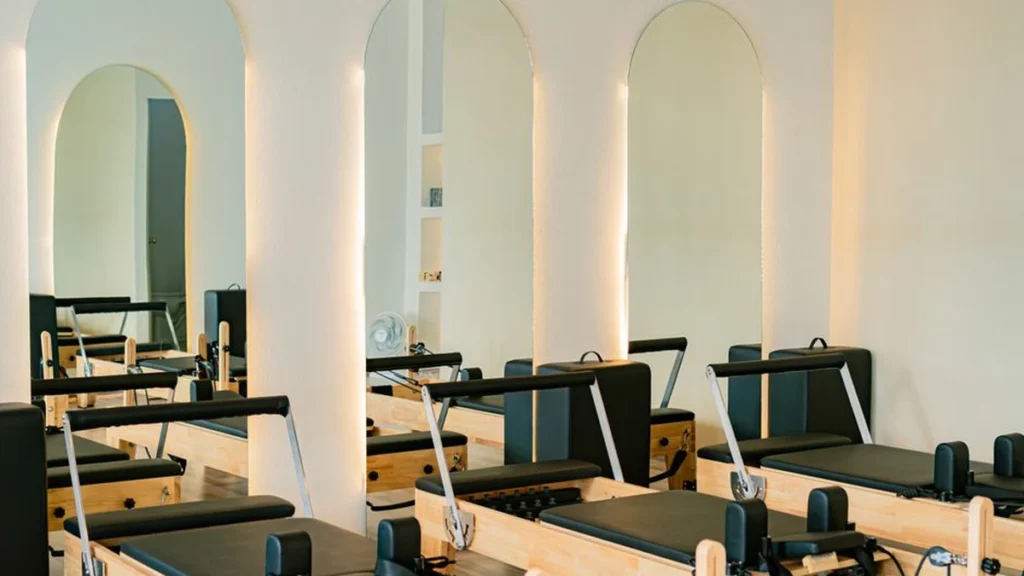
It does, and that is the clever part. Instead of loading a bar, Pilates loads your muscles with spring tension, bodyweight, and long time under tension. On the Reformer, the springs push back through every inch of a movement, so your muscles work on the way out and the slow way back. That constant load is why does pilates build muscle has a yes answer even when you never touch a dumbbell heavier than 3 pounds. The muscle does not know whether the resistance comes from iron or a spring, it only knows it is being challenged.
A single leg press on the Reformer can take eight slow seconds, where a gym rep might take two. Stretch that tempo across a 50-minute class and your muscles rack up far more working time than the light weights suggest. That is the secret behind Pilates for muscle tone: quality and control, not load.
How Pilates makes your muscles stronger
Slow, precise reps fatigue a muscle deeply, and that fatigue is the signal to adapt. You hold, you pulse, you control the return, and the smaller stabilizing muscles finally get recruited. Because the tempo stays controlled, is pilates strength training in the traditional sense? Not quite the same as a squat rack, but the strength you build is honest and it shows up in how you carry yourself, lift your kids, and climb the stairs without thinking.
In our studio we cue people to move from the deep core first, which is why so many members tell us their posture changes before the mirror does. The work tends to reach the hips, glutes, back, and abdominal wall, the muscles that hold you upright all day. When people ask does pilates build muscle mass the way lifting does, the fair answer is no, it builds refined strength and a longer, tighter shape instead. That trade suits most women perfectly.
There is a metabolism payoff too. Every bit of lean muscle you keep is tissue that burns a few more calories at rest, so building strength quietly supports a leaner body over time. It is not a dramatic furnace, but it is steady, and steady is what lasts. This is why we tell people chasing a leaner look to think in seasons, not single workouts.
How long until you feel it
Most people feel more stable and controlled within two to three weeks, and see visible tone around the six to eight week mark with two or three classes a week. Does pilates tone your body on its own? Largely yes, though pairing it with decent protein and sleep speeds things along. Results come from showing up, not from any single heroic session, and that is the honest part most fitness ads skip.
Pilates vs traditional strength training
Neither is better in a vacuum, they answer different goals. Heavy lifting chases maximum size and raw force. Pilates chases lean strength, control, joint safety, and a long, sculpted line. Many of our members run both, lifting once or twice a week and using Pilates to build the stability that makes their lifting safer. So does pilates build muscle well enough to replace the gym? For a leaner, stronger, more mobile body, often yes. For bodybuilding size, no. Here is how the two compare on the things women usually care about.
| Goal | Pilates | Traditional weight training |
|---|---|---|
| Build lean strength and tone | Excellent | Good |
| Add large muscle size | Limited | Excellent |
| Improve core control and posture | Excellent | Moderate |
| Joint-friendly, low pounding | Very | Depends on form |
| Reformer drop-in at RÓS | $40 | Not offered |
Notice that the two columns rarely fight. Pilates fixes the weak links, the deep core and the stabilizers, that heavy lifting tends to skip. Fix those and your squats, hikes, and everyday lifts all feel steadier. That is why we so often see runners and lifters use Pilates as their insurance policy against injury. If you still cannot decide whether does pilates build muscle enough to earn a permanent spot in your week, try two weeks of classes and let your own body settle the question.
Does pilates build muscle for total beginners?
Yes, and beginners often gain the fastest at first, because the movement is brand new and the muscles adapt quickly. You do not need a fitness background to start. Our instructors regularly walk first-timers through the springs, the straps, and the breathing in the opening minutes, then scale every exercise to your level. If you have been asking does pilates build muscle for someone starting from scratch, the honest answer is that this is one of the safest ways to begin building strength. Nobody is watching, and every movement adjusts to you.
Which RÓS classes build the most muscle
If strength is your main goal, start on the Reformer for spring resistance, then add Lift & Sculpt for a weights-and-mat blend. Barre layers in tiny pulses that fatigue the smaller muscles, and Mat Pilates sharpens the deep core. You can mix all of them inside one membership, or try a single Pilates class first to feel the difference before you commit.
- Reformer Pilates, spring resistance for full-body lean strength, $40 drop-in.
- Lift & Sculpt, light weights plus mat work for tone and conditioning, $35 drop-in.
- Barre, small pulses that fatigue the glutes, thighs, and arms, $30 drop-in.
- Mat Pilates, deep core and stability with your own bodyweight, $26 drop-in.
- Personal Training, one-on-one coaching to target specific muscles, $90 a session.
For steady, week-after-week progress, the membership wins on both results and value, since three classes a week adds up fast at drop-in rates. Prefer a focused plan for a specific area? Our personal training sessions let an instructor program directly for your glutes, arms, or core. Book a spot on the class schedule whenever you are ready to feel this for yourself.
Small groups, expert guidance, and a beautiful studio on Horizon Ridge in Henderson. Come see the space and meet the team.
Book a ClassOr call us at (702) 772-1271Frequently asked questions
Does pilates build muscle in your legs and glutes?
Yes. Reformer springs and barre pulses load the glutes, hamstrings, and quads through a long range of motion, so they get firmer and stronger. You will not bulk up, but most women notice tighter, more defined legs within six to eight weeks of regular classes.
Is pilates strength training or just stretching?
It is genuine strength training with a mobility bonus. Every controlled rep works your muscles against resistance from springs, bands, or bodyweight, which builds real strength. The stretching happens naturally inside the movements, so you gain both flexibility and lean power from the same class.
How often should I do pilates to build muscle?
Two to three sessions a week is the sweet spot for most people. That gives your muscles enough stimulus to adapt while leaving time to recover. Does pilates build muscle faster with more classes? Up to a point, but recovery matters, so three well-cued sessions usually beat five rushed ones.
Will pilates make me bulky?
No. It builds lean muscle and tone rather than size, because it uses moderate resistance and high control instead of heavy loads. When people ask does pilates build muscle that looks bulky, the answer is a clear no. You get a firmer, more sculpted shape and strength you can actually use.
Does pilates build muscle faster than lifting weights?
Not faster for raw size, since heavy lifting wins there. For lean strength, core control, and visible tone, Pilates is efficient and gentle on your joints. Many members pair a couple of Pilates classes each week with light lifting to get the best of both.
RÓS Pilates is a boutique wellness and fitness studio in Henderson, NV, offering Reformer, Mat, Hot Pilates, Barre, and Lift & Sculpt, plus 1:1 and duo Personal Training. Our instructors are certified and teach every class in small groups. Ready to start? Book a class or call (702) 772-1271. See all our classes.